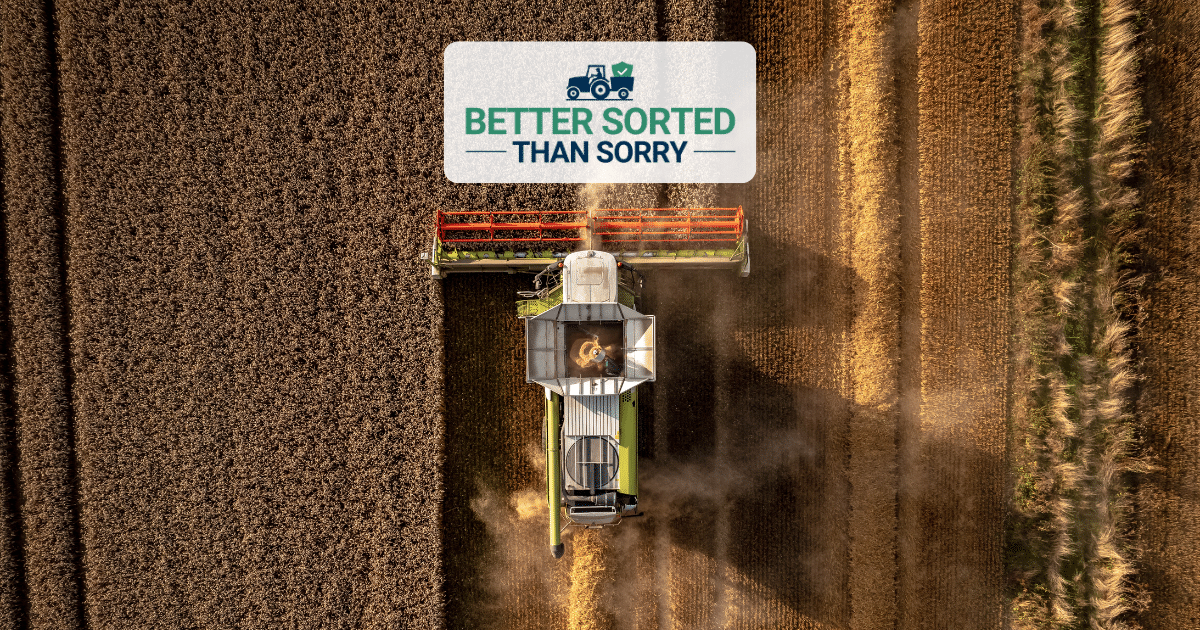
Summertime means harvest time for many of our farming clients and for our in-house claims team, it means being prepared and on standby with specialist agri-engineers to support our farming clients, should they need to make a claim.
We have seen huge losses where combine harvesters have caught fire, with crop losses for both our client and neighbouring farms, where the fire has unfortunately spread. These types of incidents can be devastating and so having the right, specialist support on hand in such instances can be invaluable in the aftermath.
Fire claims are not the only concern over summer, there are also concerns around the impact of a poor harvest, not only for farmers but for the wider rural economy – those connected industries that rely on production from the agricultural sector.
As part of our Better Sorted Than Sorry campaign, August focuses on Preventing Claims, looking at the practical steps farming businesses can take to reduce avoidable losses, minimise disruption, and keep harvest moving safely.
So what can farming businesses be doing to prepare for the summer season?
Risk management
All farmers are required to carry out a risk assessment under the Health and Safety at Work Act 1974. Farmers must do what they can to ensure the health, safety and welfare of employees and anyone else who may be impacted by what they do.
Here are just some of the things farmers need to consider when carrying out their risk assessments:
- For each hazard, farmers need to be clear about who might be harmed, such as employees, casual workers, members of the public and contractors. Farmers must consider more vulnerable people, such as new or untrained workers, visitors/the public and maintenance workers.
- How people may be harmed also needs to be thought about, for example, by a falling bale, moving vehicle, falling through a fragile roof. Long-term issues and illnesses can also be caused by inhaling grain dust or smoke from a fire.
- For hazards, look at: what you are already doing, the controls you have in place and the way work is organised – this can then be reviewed to see if anything else needs to be done to comply with regulations and in order to follow best practice.
- Whilst often hazards can’t be eliminated completely, farming businesses must try introducing a less risky option where possible, prevent access to hazards (e.g. securing a slurry pit or guarding a machine), organise work in such a way as to reduce risk exposure (e.g. putting barriers between people and vehicles), provide personal protective equipment and provide welfare facilities such as first aid and showers for removing contamination.
The steps such as those above can help in preventing accidents and damage, as well as helping you in defending liability claims that may be made against you; being able to show compliance with the HSE legislation and having discharged your duty as a business owner will put you in much better stead in such an incident.
Read about the HSE’s risk assessment guidance, specifically aimed at the Agricultural industry; this provides approved guidance on how to carry out a thoroguh risk assessment for your farming business..
Looking at harvest more specifically
During harvest, there is a lot that needs to be done in a short space of time, along with a lot of large machinery being involved. Naturally, this time of year sees an increase in vehicle movements, which – according to the HSE – has been the number one cause of deaths and serious injuries on British farms over the past 5 years.
This time of year can also involve working in dusty conditions or at height, which again poses a risk to workers if appropriate equipment, protection and steps are not in place and implemented. Farm machinery and equipment used during harvest time are typically left dormant until the season comes around, meaning these items can gather combustible debris and dust, and wiring can be damaged by rodents. It is therefore good practice to thoroughly service and check all systems in advance, including auxiliary items such as trailers, augers, fuel bowsers and the like – not just the main combine rig. Using an air compressor at reduced pressure to regularly blow out debris from the machine can also be helpful.
Farmers must also ensure there is a fire extinguisher easily accessible and in good working order on each machine, and that workers are aware of the fire and emergency plan, including having a water bowser on standby or being aware of nearby water sources.
Better Sorted Than Sorry
Harvest will always bring pressure; weather changes, machinery failures, and unexpected challenges arise. But some of the most disruptive incidents don’t begin with major failures, they begin with small issues that were easy to overlook or miss at the time. A missed check, a delayed repair, a shortcut taken at the end of a long day.
The purpose of our Better Sorted Than Sorry campaign isn’t to tell farmers how to farm, it’s to encourage practical, preventative actions that help reduce risk before problems have the chance to grow and evolve.
How we can help
Our in-house claims team are here to help you in the event you need to make a claim, guiding you through the process and supporting you with the goal of ensuring you achieve a fair and efficient settlement.
Our role is also to ensure you are aware of any steps you need to take so as to not prejudice or inadvertently delay your claim. For example, making sure you know to notify us immediately of a claim and of any urgent repairs undertaken to keep harvest productive; if we are informed even just a week or two later, insurers will be unlikely to accept this information, which could lead to them avoiding a claim later down the line. Equally, making sure you know to retain any damaged parts and to take plenty of photos to evidence any damage, as well as any other pertinent information or evidence.
It is also part of our role to ensure that insurers understand the urgency of getting our clients back up and running – particularly important during harvest which is so time sensitive. We will also work with agricultural loss adjustors and engineers so that they are ready and on standby to attend your property should a claim arise.
To find out more about how McClarrons can help you during the harvest season, or for a complimentary insurance review, please contact our Farm Team at farm@mcclarroninsurance.com or on 01653 609152.
Other resources:
Keeping you and your machinery safe this harvest season
Preventing business interruption this summer