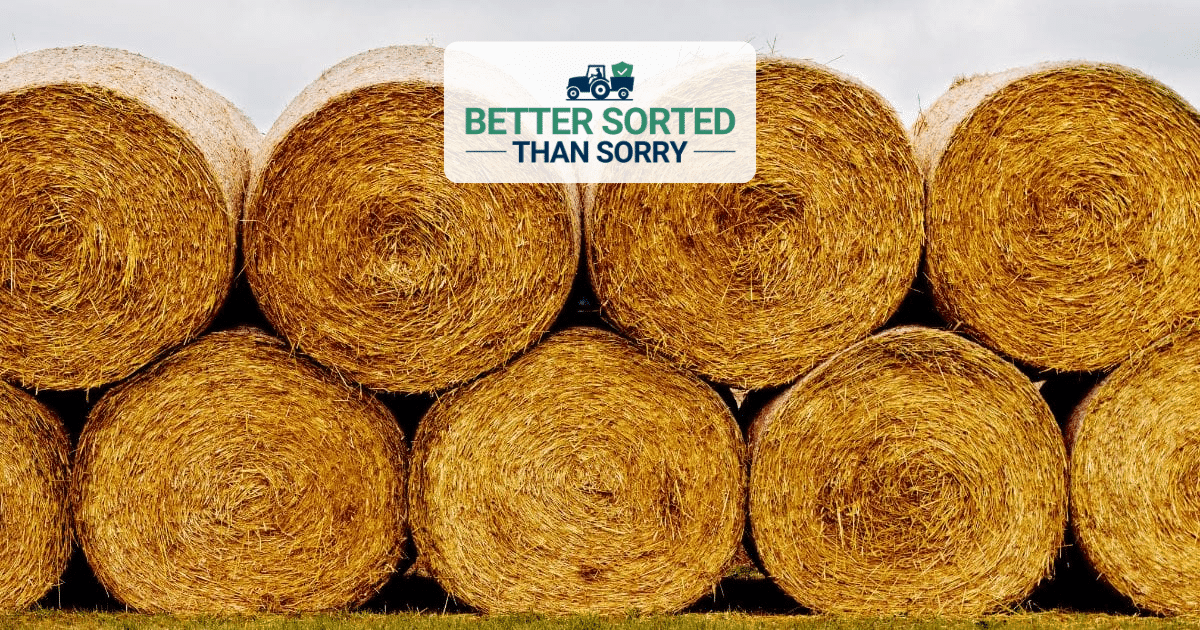
By the time harvest is underway, many farmers are focused on getting crops safely gathered, moved and stored before the weather changes. But once the baler leaves the field, the risks don’t disappear. Poorly stacked bales, unstable storage areas, fire risks, machinery incidents and public safety concerns can all create problems long after harvest has finished.
As part of our Better Sorted Than Sorry campaign, we are looking at why safe stacking matters and the practical steps that can help reduce avoidable incidents, injuries and claims.
Proper stacking procedures are crucial for supporting harvest safety and the integrity of crops during transportation and storage. Additionally, they support efficient handling and shipping of the harvest and can be key in preventing harm to farmers and their businesses. Incorrect stacking techniques can pose safety risks for farmers and their employees, resulting in potentially very serious injuries. This blog provides a reminder for effective stacking procedures to help minimise risk and promote harvest safety. This information is intended as general guidance only. Farmers and businesses should always consult official guidance issued by the HSE. For further information, read Safe working with bales in agriculture.
Identifying Stacking Risks
Stacking is typically done on firm, dry ground with proper drainage, with produce arranged in a way that helps ensure it is in good condition and can be easily transported and stored.
However, before starting any stacking operation, it is important for farmers and workers to conduct a thorough risk assessment to identify potential hazards and implement preventive measures. This includes assessing the weight and stability of stacks, ensuring proper placement of produce, and considering factors such as weather conditions and the type of harvest being stacked. Moreover, it also essential to understand the type of harvest and its specific needs with regards to stacking. The HSE provides guidance around working safely with bales, here.
Key Safety Measures for Effective Stacking
Farmers with a public right of way in their field have a duty of care towards those visiting to protect them from the risks associated with bales. Unfortunate incidents have occurred in the past where children have been tempted to climb on these stacks and have either fallen or been crushed to death as a result. To help prevent such tragedies, it must be ensured that crop bales are stored away from public right of ways and if this is not possible, must be removed as soon as possible. Moreover, proper warnings and danger signs should be posted, and the public paths must be separated from bales by means of effective fencing.
Another safety hazard surrounding bale stacks is spontaneous combustion, which occurs due to the growth of mesophilic bacteria in damp crops, leading to severe financial loss for farmers.
While baling in the dryer months is the best way to prevent unexpected fires, we all know that the weather can be extremely unpredictable. Sometimes, carrying out out baling later in the day can be a good option, when moisture levels are generally lower. Another useful way to monitor safety of crops is to regularly use a thermometer to check that the temperature inside the bales remains under 55 degrees Celsius.
Here is a checklist of just some of the preventive measures that all farmers can carry out before and during stacking operations:
- Ensuring all equipment involved in the stacking process is in good repair and properly maintained.
- Making sure bales are tight and compact, and are stacked away from overhead cables, with small gaps left between each stack to allow air flow.
- Ensuring the ground is moisture-free with a steady base to ensure even distribution of weight, and to assess the capacity of the stack and adhere to recommended limits.
- Checking weather forecasts in advance as you ordinarily would, to plan for rain, wind, or extreme temperatures to help avoid contamination of the harvest, and to prevent the chances of stacks from collapsing and causing injury.
- Avoiding placing bales near roads as that may increase the risk of an arson attack. Take a look at North Yorkshire Fire & Rescue Service’s advice on the issue, here.
- Regularly monitoring bales and their temperature to help prevent them catching fire through spontaneous combustion.
- Providing workers with Personal Protective Equipment (PPE), such as gloves and safety boots, to help protect against potential hazards like cuts, falls and exposure to harmful substances.
By conducting thorough inspections and making necessary preparations, farmers can enhance the safety of their stacking operations and help prevent unnecessary incidents and claims.
Legal Considerations and Compliance in Stacking
Complying with legal regulations is a crucial part of supporting the safety and compliance of stacking operations.
Taking all necessary measures to prevent accidents, such as understanding the legal requirements for stack layout, equipment maintenance, and the use of personal protective equipment can be the difference between a normal working day and a devastating incident. By doing so, in the event of an investigation following an incident, farmers are also in a much better position to defend themselves when they are able to show that all relevant checks and precautions were undertaken to help prevent the incident from happening in the first place.
Additionally, farmers should comply with insurance limits on stacking hay or straw; for example, some policies may mandate that each stack be valued at less than £20,000 and placed no more than 20 meters away from other stacks and any combustible materials. Violating these conditions could result in the insurance cover being void and ultimately, a claim not being paid.
Furthermore, farmers must ensure all lifting machinery is thoroughly examined by a competent person as per the Lifting Operations and Lifting Equipment Regulations 1998 (LOLER) to remain compliant. LOLER requires a detailed report to be generated on all potential failures, with recommendations provided to the lifting machinery owner by trained inspectors. Complying with LOLER recommendations helps ensure that all businesses utilising lifting equipment uphold their duty of care towards those operating it. Again, in the event of a claim, this could become vital to your defence and to support your insurance claim itself.
Insurance Solutions for Stacking Associated Risks
We would like to take this opportunity to remind you of Rural Protect – a specialist Management Liability insurance policy designed by us with farming businesses in mind, and how it can assist with regulatory and health and safety risks. Read our blog about how can Rural Protect can benefit farming businesses and protect them from an array of risks, here.
Rural Protect can respond to incidents if a regulator becomes involved; for instance, if an incident is reportable under RIDDOR (Reporting of Injuries, Diseases, and Dangerous Occurrences Regulations), the insurance policy’s legal team, rradar, would assist with reporting it to the HSE. A thorough report of the incident will be required due to a potential breach of regulations so the support of rradar can be invaluable and allows you to continue attending to the incident while ensuring compliance. With no prospect of success clause applying for defence claims, those insured by Rural Protect can rest assured that if they have inadvertently done something wrong, rradar can still support in defending them.
Also working in tandem with Rural Protect are policies such as:
- Farm Combined – to cover material damages to the farm, equipment, buildings and the like.
- Public Liability – to provide cover for harm or damages to a third party, for example, if a bale falls off a farmer’s trailer when being transported, onto the roof of someone’s car and causes damage.
- Employers’ Liability – to cover the legal costs and compensation if a worker is harmed during the course of their work, for example, during the stacking or removal process. You can read one of HSE’s articles about such an incident, here.
Better Sorted Than Sorry
The purpose of our Better Sorted Than Sorry campaign isn’t to add to farmers’ workloads; it’s to encourage practical actions that can help prevent avoidable problems before they have the chance to grow.
Whether it’s a machinery fire, a collapsed stack, an injury, or damage to stored crops, it often only takes one thing to change everything.
How McClarrons can Help Farmers
As a specialist rural insurance broker of over 35 years, it is part of our role at McClarrons to ensure that farming businesses are adequately protected and have the right policies in place, working with our clients to ensure they have comprehensive cover that protects their business risks and needs.
To find out more about how McClarrons can help safeguard your farm and livelihood, or for a free review of your insurances, you can contact our Farm Team at farm@mcclarroninsurance.com.